
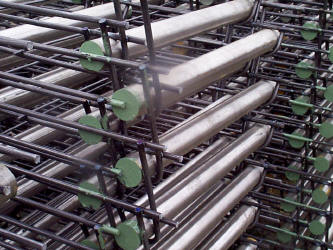
Concrete slab dowel bars are used to transfer the load from one slab to another whislt permitting axial thermal expansion along the axis of the dowel. Austenitic stainless steel dowel bars are generally produced from plain round material. They provide a durable, corrosion resisting solution to connections in concrete or other structural applications. Available in a range of sizes, material grades and strengths, there is a suitable dowel bar for most requirements. BS6744 round bar is supplied in the standard diameters and in the grades
Specification Options
Dowel bar ends are typically sawn and therefore clean of burrs. If this is not a requirement, then the more economic sheared ends may be supplied, this should be clearly indicated at order stage.
Dowel bars are short steel bars that provide a mechanical connection between slabs without restricting horizontal joint movement. They increase load transfer efficiency by allowing the leave slab to assume some of the load before the load is actually over it. This reduces joint deflection and stress in the approach and leave slabs.
Dowel bars are typically 32 to 38 mm (1.25 to 1.5 inches) in diameter, 460 mm (18 inches) long and spaced 305 mm (12 inches) apart. Specific locations and numbers vary by state, however a typical arrangement might look like Figure 1. In order to prevent corrosion, dowel bars are either coated with stainless steel (Figure 2) or epoxy (Figure 3). Dowel bars are usually inserted at mid-slab depth and coated with a bond-breaking substance to prevent bonding to the PCC. Thus, the dowels help transfer load but allow adjacent slabs to expand and contract independent of one another. Figure 3 shows typical dowel bar locations at a transverse construction joint.
Designed and Edited By:
Mujtaba Hussain (M.E,Mech. Engineer, Dubai,U.A.E)
